The AI world just witnessed one of its biggest surprises this year. An anonymous coding model that quietly dominated the OpenRouter leaderboards for months has finally been revealed as the creation of Meituan, a company previously better known to the public as a Chinese food delivery app. This disclosure is not just a “who’s behind the mask” drama, but also carries major claims about China’s ability to train frontier-class models without relying on Nvidia chips at all.
Why Owl Alpha Disappeared from OpenRouter
Since late April 2026, a model named “Owl Alpha” appeared on OpenRouter with no information about its developer. The practice of releasing models anonymously before an official launch is not uncommon in the AI industry; it is usually used to test market response and gather real-world usage data before a lab attaches its big name. But Owl Alpha’s “stealth” period lasted much longer than most similar cases, almost two full months.
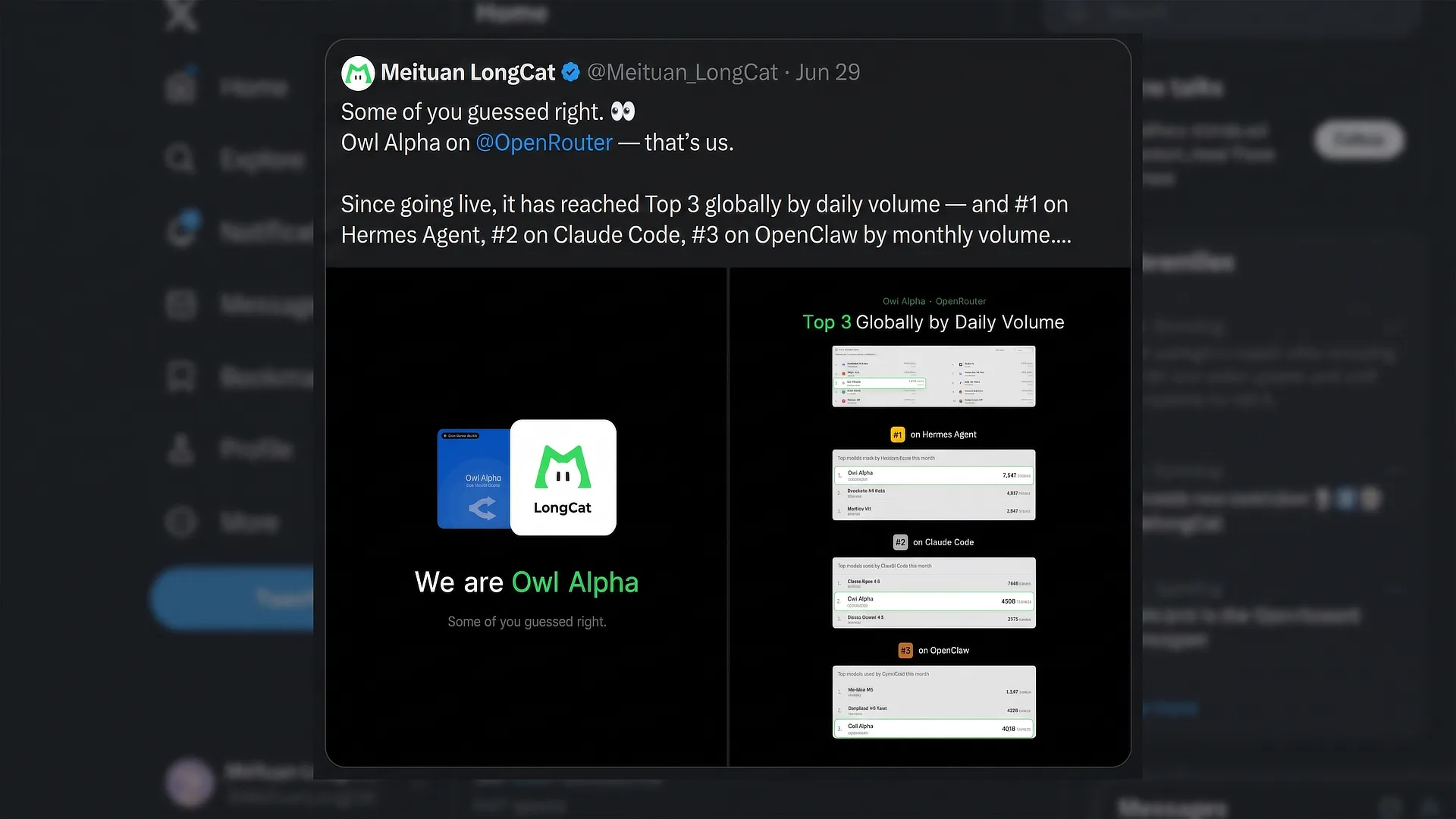
On June 29, 2026, its anonymous status officially ended. LongCat’s official X account posted a brief announcement confirming that Owl Alpha is theirs. A day later, on June 30, Meituan released the model openly under the name LongCat-2.0 via GitHub, Hugging Face, and their own platform. With that, the name “Owl Alpha” practically retired from OpenRouter, replaced by its official identity as part of the LongCat family.
Who Exactly Is Owl Alpha
During its anonymous period, Owl Alpha’s performance was far from ordinary. The model had previously held the number one position in the Hermes Agent category, number two in Claude Code, and number three in OpenClaw—three usage pathways that are quite dominant among developers relying on AI for daily coding tasks. In terms of volume, Owl Alpha was estimated to process around 10.1 trillion tokens per month, with an average of 559 billion tokens per day, and a monthly growth of 242 percent. These numbers are extraordinary for a model that carried absolutely no big name behind it.
This is exactly where the surprise lies. A usage scale of this magnitude is usually only achieved by models from widely known labs like OpenAI, Google, or Anthropic. The fact that a company synonymous with food delivery and online ride-hailing could build and quietly maintain such a large model on the open market—without many realizing it until they themselves revealed their identity—is the most fascinating part of this whole story. Several observers had even speculated about Owl Alpha’s identity before the official announcement, noting similarities in its developmental patterns to previous LongCat models.
LongCat-2.0, Specifications, and Infrastructure
In terms of architecture, LongCat-2.0 is a Mixture-of-Experts model with a total of 1.6 trillion parameters, but only about 48 billion parameters are active for each token processed, with a dynamic active range of between 33 billion and 56 billion depending on task complexity. The model was trained on more than 30 trillion tokens of data and natively supports a context window of up to 1 million tokens, one of the largest in the current open-source model class. To maintain efficiency at such a massive context scale, the LongCat team developed a mechanism called LongCat Sparse Attention (LSA), an evolution of the sparse attention approach popularized earlier by DeepSeek, with refinements in three areas: memory access efficiency, utilization of attention pattern similarities across layers, and the suppression of quadratic computational costs that usually hinder high-precision sparse attention mechanisms.
Regarding licensing, Meituan opted for the highly permissive MIT route, allowing anyone to modify and embed LongCat-2.0 into closed commercial products without the obligation to open-source the derivative code. It is worth noting, however, that as of this writing, LongCat-2.0’s official pages on GitHub and Hugging Face still state that the full model weights are “coming soon,” meaning the model files cannot yet be fully downloaded and independently tested by the public.
In terms of benchmarks, the results are not uniform across all fields. LongCat-2.0 outperforms Gemini 3.1 Pro and GPT-5.5 on SWE-bench Pro (59.5) and SWE-bench Multilingual (77.3), two tests focusing on real-world software engineering tasks, though it still falls below Claude Opus 4.7 and 4.8. Conversely, on IFEval (90.0), IMO-AnswerBench (81.8), and GPQA-diamond (88.9)—which measure compliance with complex instructions and advanced science and math reasoning—LongCat-2.0 lags quite far behind Gemini and GPT-5.5. This pattern solidifies LongCat-2.0’s position as a highly capable model specifically in the realm of agentic coding, rather than a jack-of-all-trades across all domains.
The most widely discussed aspect is actually its infrastructure claims. Meituan states that the entire training process, encompassing more than 35 trillion tokens, was run entirely on a cluster of over 50,000 domestically produced Chinese AI ASIC chips, without a single Nvidia chip involved, neither in the training phase nor in serving the model to end users. This claim is significant considering that US export controls on high-end Nvidia chips to China have been in place since 2022, with the explicit goal of hindering China’s ability to train frontier-scale AI models. What makes this achievement feel even more substantial is that the LongCat team was only formed in 2023, and their first model was released late last year, meaning the leap to a globally competitive 1.6-trillion parameter model occurred in less than three years.
Nevertheless, this claim still has gaps that need to be scrutinized. Meituan did not specifically name the domestic chip manufacturer they used, and because the model weights have not been fully released to the public, outside parties cannot yet conduct comprehensive independent verification of these infrastructure claims.
From a business model perspective, Meituan applies an aggressive pricing scheme to attract developer adoption. Every context cache-hit—meaning parts of the conversation that have been processed previously and are reused—is completely free, and they also briefly offered “Token Pack” promotions in the form of limited-time flash sales. This low-cost pricing approach has become a common pattern among recent Chinese open-source models, offering near-top-tier performance at a significantly lower cost compared to closed models from major Western labs.
Conclusion
The emergence of LongCat-2.0 cannot be separated from the increasingly tense AI geopolitical context throughout 2026. Not long ago, following a US government request, OpenAI was forced to restrict access to its latest model, GPT-5.6, while Anthropic was previously ordered to restrict access to Claude Fable 5 and Mythos 5 until they were ultimately withdrawn entirely from public circulation. Some observers argue that such restrictive policies could actually backfire, as they push developers worldwide to turn to cheaper and more open alternatives like LongCat-2.0.
What still needs to be proven moving forward is the release of full model weights to enable thorough independent verification, and whether LongCat’s popularity can endure under its real name, considering much of its appeal so far stemmed from public curiosity surrounding the Owl Alpha mystery, rather than LongCat brand awareness itself. Despite the various questions that remain open, one thing is clear: top-tier AI model competition is no longer an exclusive arena for a handful of large American labs, and a company like Meituan has proven it deserves a seat at the table.