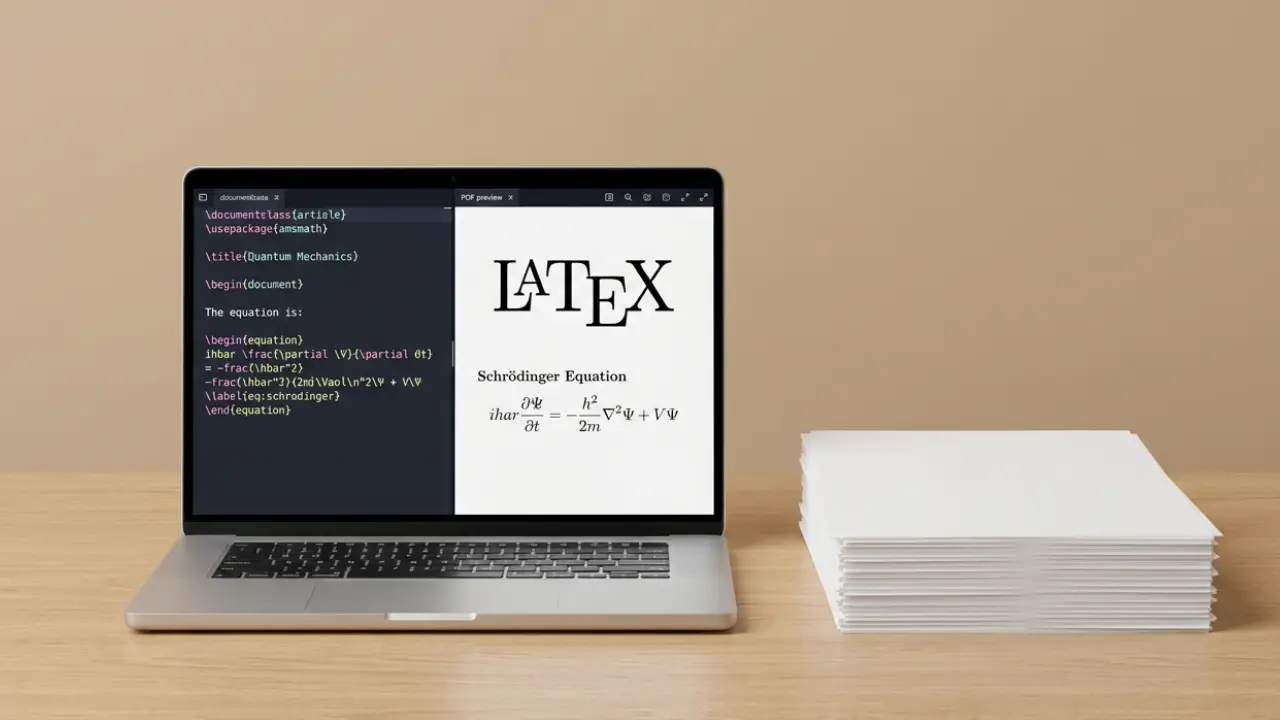
For most people, writing documents is synonymous with opening Microsoft Word or a similar application—programs with a visual interface (GUI) where you can see the final layout while typing. However, among academics, particularly in mathematics, physics, statistics, and linguistics, there is a much more popular typesetting system. It is called LaTeX.
Unlike Word, LaTeX does not display the finished document immediately. Instead, users write in plain text using specific markup commands—similar to writing code—which is then compiled to produce the final document. The output is typically a highly polished and consistent PDF. While this workflow might feel foreign to those used to conventional word processors, it is precisely this method that makes LaTeX so widely loved in the scientific community.
Historical Background
The roots of LaTeX go back to TeX, a typesetting program developed by Donald Knuth in the late 1970s. Knuth, a highly respected figure in computer science, created TeX out of frustration with how mathematical formulas were laid out in the computer-generated proofs of his books. While older printing technologies produced neat results, the transition to early computerized printing was disappointing to him. This led him to build a system from scratch that could produce high-quality mathematical typesetting.
TeX was released as free and open software, prompting wide adoption and the development of various macros (additional command sets) to simplify its use. About five years later, in the early 1980s, Leslie Lamport, another influential computer scientist, compiled these macros into a structured and more user-friendly package. This package became known as LaTeX. Lamport published a user manual, and from that point on, LaTeX gradually became the standard across many scientific fields.
Since TeX was open and free to modify, Lamport did not own LaTeX exclusively. In the late 1980s, he handed over the maintenance and future development of LaTeX to the TeX Users Group (TUG), and the two systems have been managed together ever since. While some purists strictly distinguish between TeX and LaTeX, the two terms are often used interchangeably in everyday conversation.
Why Scientists Prefer LaTeX Over Word
Built Specifically for Mathematical Notation
Because LaTeX was born from a mathematician’s desire for neat formulas, writing mathematical notation—such as fractions, integrals, special symbols, and non-Latin characters—is far more natural than in general word processors. Word was primarily designed for general text rather than complex scientific notations. Typing long formulas in Word often requires clicking through multiple menus and buttons repeatedly, whereas in LaTeX, it only requires typing specific syntax. Once mastered, this syntax is much faster and yields more consistent results.
Separating Content Writing from Formatting
One of the most fundamental reasons people switch to LaTeX is the strict separation between content writing and visual styling. In GUI-based applications like Word or PowerPoint, users often get distracted adjusting image alignments, changing fonts, or picking colors before they even finish writing their sentences. These formatting steps disrupt the core writing process.
In LaTeX, the author only needs to focus on the content and structure of the document—such as headings, paragraphs, and references to figures or tables—without worrying about the layout. The system automatically handles the positioning of these elements during compilation into a PDF. Adjustments can be made later, but the writing flow remains uninterrupted. This principle of separating content from presentation is the hallmark of the LaTeX approach. For scientific writers, this workflow is far more efficient than constantly wrestling with images or tables that shift unexpectedly, a common annoyance in Word.
Consistency and Reliability of the Final Output
Since document formatting is defined by pre-established rules and templates, the final output in LaTeX is highly consistent. Page numbers, reference layouts, and mathematical equations remain perfectly aligned without requiring manual adjustments after edits. For those writing long, complex documents like research papers, theses, or reports, this consistency is a massive advantage over conventional word processors, which offer instant visual ease but often suffer from messy layout breakages as content grows.
Open and Free to Use
From their inception, TeX and LaTeX were developed as open-source software that anyone could use, modify, and distribute for free. This open nature has driven its widespread adoption in academia, where institutions and researchers seek options free from expensive licensing fees or proprietary software lock-ins.
Conclusion
LaTeX may seem more complex on the surface compared to visual word processors, but this initial learning curve forms the foundation for cleaner, more consistent, and highly professional scientific documents. Born out of a mathematician’s actual needs and built on the philosophy of separating content from presentation, LaTeX remains the premier choice for complex, notation-heavy academic documents.